
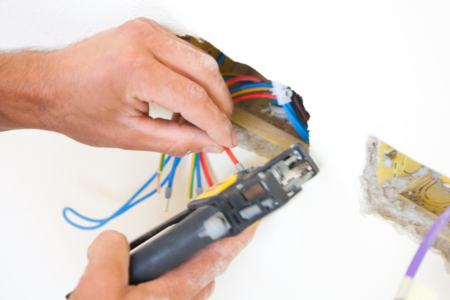
Older homes can be affordable for first-time buyers or appeal to those wanting a vintage house. However, it’s important to remember that the code and building requirements enforced today weren’t the same as when many older homes were built. As a homeowner, it helps to understand how older electrical wiring varies from what you’ll find in homes constructed today.
Types of Wiring Over the Years
Over the years, the electrical industry has used many different types of wiring. Unfortunately, some types have been deemed dangerous and potential fire hazards. If you already own an older home or are in the market for one, it is critical to understand the different types of wiring used in the past.
Knob and Tube
Probably one of the most prominent older style wiring that homeowners learn about is knob and tube. Knob and tube was most popularly used between the late 1800s and the mid-1900s, as it was the first style of electrical wiring used in homes. The knob and tube consisted of two main wires, a black live wire and a white neutral wire. Both of these wires were covered in a rubberized fabric and were connected to porcelain knobs. The main problem with knob and tube wiring is that it lacks any ground wire, which is necessary to meet current electrical codes.
NMC
NMC started being used in the 1920s. It’s considered the first generation of sheathed wiring introduced into the electrical marketplace. It consists of both a hot and neutral wire covered with fabric sheathing. Fabric sheathing is a protective layer for the wiring to prevent unwanted arcing and other related issues. In later years, NMC wiring began to include a grounding wire, which improved safety by providing a path for electrical current to dissipate in case of a fault. This type of wiring is still commonly used today, though modern versions have improved materials and insulation standards to meet current electrical codes and safety requirements.
Romex
Also known as non-metallic cable, Romex hit the marketplace in the 1950s and has become the most popular wire installed in homes. It consists of a plastic sheathing instead of a cloth one. Cloth has been shown to deteriorate over the years and lead to unwanted electrical hazards, like household fires. Romex also comes with a ground wire for household safety.
Aluminum Wiring
Aluminum wiring made its short debut back in the 1960s to 1970s. It was promoted as an alternative to traditional copper wiring inside the standard Romex. Despite its initial popularity due to its lower cost and lighter weight, aluminum wiring has been phased out due to its high potential for creating an electrical fire. Aluminum wire connections tend to loosen over time, leading to increased electrical resistance and overheating. Additionally, aluminum is more susceptible to corrosion and oxidation, further increasing the fire risk. As a result, many building codes now require copper or other safer alternatives for electrical wiring.
Household Amperage
When the electrical company introduces power into a home, they give a set amount of amperage. In homes before 1970, the typical household was given 60 to 100 amps. This was adequate for that day and age, as homeowners had few electrical demands. Fast-forward to modern-day homes, and the standard is 200 amps. This is because the average household uses many more electronics and appliances.
Understanding the amount of amps coming into your older home is essential. If you only have 60 or 100-amp service, then you’ll likely experience an inadequacy when running your electronics. Common problems with insufficient amperage include flickering lights and constantly tripping circuit breakers. You can typically tell how much amperage you have by looking at your main panel box. Where the main switch is located, there is generally a marking indicating how much amperage there is, such as 100 or 200. Upgrading to a higher amperage service may be necessary to meet modern appliances’ electrical demands and ensure the safety and efficiency of your home’s electrical system.
Fuse Boxes Versus Circuit Breakers
In the early days of electricity, the main power box for a home was referred to as a fuse box. It consists of various fuses associated with the different circuits throughout your home. Whenever a circuit experienced a problem, it would blow out the fuse for that circuit. Blown fuses stopped power, which prevented issues like electrical fires. While fuse boxes were popular until the late 1950s, they had one big inconvenience.
Every time you blew a circuit fuse, you physically had to remove the fuse and replace it with a fresh one. Homeowners had to keep multiple new fuses on hand for an immediate fix or wait until they could get to their hardware store to get a new one. Additionally, the fuse had to be rated for the specific amperage that the circuit required. For example, a 15-amp fuse must replace a 15-amp circuit. If you had a 30-amp fuse blow, you couldn’t replace it with a 15-amp fuse.
In the 1960s, a new invention, the circuit breaker, emerged. These were installed in panel boxes, like those you’ll see in modern homes. Each circuit breaker controls an individual circuit for your home. Depending on usage, the circuit is marked with its amperage rating, such as 15-amp or 30-amp. The main advantage of circuit breaker boxes over fuse boxes is that you can simply flip the circuit breaker back to the on position and continue like usual.
Difficulty Identifying Old Wiring
When dealing with old household wiring, you can expect it to be challenging. Old wiring tends to be worn out and deteriorated. In older knob and tube wiring setups, it can be quite tricky to determine the difference between the hot black and white neutral wire. As dirt and grime get over the wires as they deteriorate, both wires can appear to have a black cloth surrounding them. This makes it hard to distinguish visually between the hot and neutral wires. It will take an electrician to use a multimeter to determine what wire is hot and which is neutral.
DIY Tampering
In the past, it was common for homeowners to try and do DIY repairs or hire a handyman to save money. Unfortunately, this has left many older homes with unsafe wiring and potential hazards.
For example, the wiring code requires different sheathing colors for other wires. The live wire should always be black. The neutral wire will always be white. If there is a second live wire, it will be red. The ground wire is always the bare wire. In older homes, you may find that these colors don’t always align with the actual wire. This is because homeowners or unlicensed individuals used whatever wire was on hand to complete the task.
Reliable Electrical Service
Acosta Heating, Cooling & Electrical has been serving the residents of Charlotte, NC, since 1972. Over the years, we have developed our business to become your one-stop shop for all your home service needs. We install, maintain, and repair heating and cooling systems. Additionally, we are expert electricians who can rewire your home, upgrade your electric panel, or install modern necessities like surge protection and EV stations. Contact us today to schedule an appointment with one of our experienced team members.